Groundwater · Technical note
What a groundwater investigation should establish before drilling
A borehole location is a reasoned technical choice - not a guarantee of yield. Good investigation makes the evidence, uncertainty and next steps clear.
Start with the decision the investigation needs to support. Review available geological and hydrogeological information, existing water sources and practical site constraints. This context helps frame the fieldwork and prevents a single survey result from being treated as a complete answer.
Combine field observations with appropriate geophysical methods and hydrogeological interpretation. Survey quality, local geology and the assumptions used in interpretation all affect confidence. Where more than one location is feasible, compare the options and explain the trade-offs.
- State the methods used and the limits of the available evidence.
- Give a clear siting recommendation with an appropriate level of confidence.
- Carry the investigation through to drilling supervision, construction records and performance testing where the assignment requires it.
The aim is to reduce avoidable uncertainty and support a well-informed drilling decision. Only drilling and subsequent testing can confirm the final borehole conditions and performance.
Water engineering · Technical note
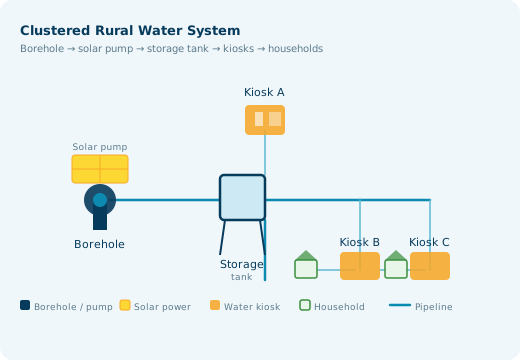
Design a water supply as one connected system
A reliable source is only one part of a dependable service. Engineering decisions need to connect source, energy, storage, water quality, distribution and operation.
Begin with the service need and the conditions at the source. Assess expected demand, source performance and water quality, then check that pumping, energy supply and storage work together. A mismatch at any point can affect the quantity, continuity or safety of water delivered.
Consider the whole route to the user: treatment where required, network layout, pressure or delivery arrangements, controls and access for maintenance. Design choices should reflect local operating capacity as well as construction requirements.
- Check key assumptions about demand, source yield and operating hours.
- Plan commissioning and testing before handover.
- Make routine operation, maintenance and clear responsibilities part of the design conversation.
Thinking system-wide helps teams identify constraints earlier and plan infrastructure that can be operated and maintained in its real context.
Climate & resilience · Technical note
Plan water services for a changing climate
Climate resilience is built through practical choices: understanding local risks, protecting sources, monitoring performance and preparing services to respond to change.
Use local climate and water-resource evidence to understand relevant pressures, such as seasonal variability, drought or flooding. The useful time horizon and level of detail depend on the project; assumptions and uncertainty should be made explicit rather than hidden in a single forecast.
Connect the risk assessment to decisions about source reliability, infrastructure siting, storage, demand management and maintenance. Where a service depends on one critical asset or source, consider how disruption would be detected and what practical response options are available.
- Protect water sources and infrastructure from identified local hazards.
- Track meaningful indicators such as source performance, service continuity and water quality.
- Review operating plans as field evidence and local conditions change.
Resilience is an ongoing management task. Project-specific decisions still require local investigation, engineering review and compliance with applicable standards.